
Manual Reports vs Odoo Dashboards: What You’re Losing Every Month
Muhammad Haroon
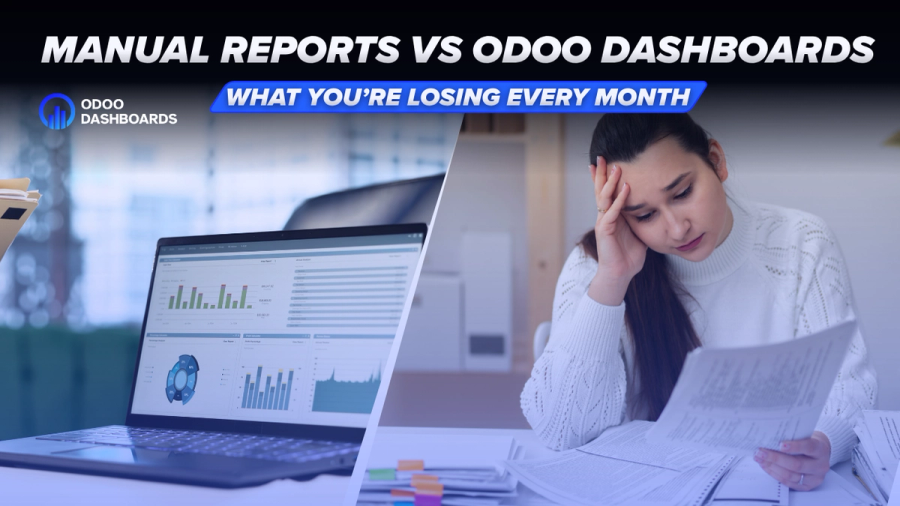
Whenever you ask business owners how they manage their work, you get almost the same answer: Excel sheets, exported reports, and a bunch of files shared over email. They built templates, added formulas, created reports, and continued that kind of work. It works until it doesn’t. Every month you stick with manual reports, you’re quietly losing time, money, and opportunities. And those small inefficiencies, repeated every week, turn into real financial losses by the end of the month.
The majority of firms are unaware of the fact that only finance teams spend more than fifteen hours per week on manual reporting. To take advantage of these opportunities, you will require automated dashboards such as Odoo. It's not only helpful to make reports look better but also to completely change how a business understands its data.
So let’s discuss this magical tool and show you manual reports vs Odoo dashboards so you see how much you are losing now.
The Reality of Manual Reporting in Most Businesses
Manual reporting starts simply, like first:
- Data exported from multiple systems
- Cleaned and adjusted in Excel or Google Sheets
- Formulas added manually
- Charts created for presentation
- Final report shared via email or PDF
It seems very structured when you do this but in actuality, it's slow, repetitive and fully dependent on human effort.
If you multiply that process by:
- Multiple departments
- Weekly or daily reporting
- Human errors
- Last-minute changes
Suddenly, the thing that you consider simple becomes a time-consuming cycle. Over time, these repetitive processes become the biggest barrier to your productivity. The time that your team could spend improving customer experience, closing deals, or planning growth strategies.
What Is an Odoo Reporting Dashboard?
An Odoo Reporting Dashboard replaces all of that manual effort with a centralized and real-time system. Instead of pulling data from different tools and compiling it manually, Odoo connects everything inside one platform. They pull data directly from your systems and update automatically in real time. There’s no need to export files, update formulas, or double-check numbers. Sales, CRM, inventory, accounting, and marketing data, everything is connected, accurate, and instantly accessible. With the help of Odoo:
- Data updates automatically
- Display insights visually (charts, graphs, KPIs)
- You can drill down into details instantly
- No need to recreate reports every week
A well-built Odoo Dashboard for Reporting gives you a live view of your business. You’re not looking at last week’s numbers. You’re seeing what’s happening right now.
Manual Reports vs Odoo Dashboards: The Real Differences
Time: Manual Work vs Automation
Manual tasks rely on humans which means these tasks are limited and take more time to complete. Manual Reports are
- Time-consuming data entry
- Repetitive tasks every week
- Delays in report generation
Odoo Dashboards:
- Automated data syncing
- Instant updates
- No repetitive work
What are you losing monthly?
Lot of productive hours that could be used for strategy, sales, or growth. Instead, they’re stuck doing data entry and fixing spreadsheet issues.
Accuracy: Human Error vs System Reliability
Manual reports depend on people.
And we understand that people, no matter how skilled, can make mistakes.
A small mistake like:
- A wrong formula.
- A missed row.
- An outdated dataset.
can completely distort your report. The worst thing is that these errors often go unnoticed until they’ve already influenced important decisions.
With Odoo dashboards:
- Data flows directly from your system, so no room for human errors here
- No manual calculations
- Minimal risk of error
You’re working with real, consistent data that you can trust. This builds confidence across your organization because everyone is looking at the same numbers.
What you’re losing monthly:Confidence in your data.
Speed: Delayed Reports vs Real-Time Insights
Another major limitation of manual reporting is timing. By the time a report is created, reviewed, and shared, the data is already outdated.
Why?
Because they represent data from:
- Yesterday
- Last week
- Or even last month
In short, you're making decisions based on past events rather than current events. And these delays mean a loss of opportunities that cost you. It can be an unexpected drop in sales, a shortage of inventory, or a modification in consumer behavior. Waiting for the next report means you’re always reacting late.
Odoo dashboards solve this:
- Live updates
- KPIs in real time
- Immediate insights
This means that you can react to changes in real time rather than after they occur. For example, if sales suddenly drop, you'll be able to identify the reason right away. If a product is doing well, you can quickly take advantage of its momentum.
What you lose every month:
The ability for quick action.
Visibility: Scattered Data vs Centralized Intelligence
Then another big issue many businesses have is visibility when relying on manual reports.
Manual reporting means:
- Multiple files
- Different versions
- Confusing data sources
It’s messy.
With Odoo dashboards:
Odoo dashboards bring everything into one place:
- Sales performance
- Inventory levels
- Financial data
- Operations
You can see everything in a single, unified view. This transparency keeps teams in touch and enables owners to make better decisions.
What you lose each month:
Clarity throughout your company.
Scalability: More Work vs Smarter Growth
As your business grows, manual reporting becomes even more problematic.
Scaling with Manual systems:
- More data means more work
- More reports mean more complexity
- More people mean more chances for errors
Odoo dashboards grow with you:
On the other hand, Odoo dashboards are designed to grow with your company. Large volumes of data can be handled easily without slowing down or becoming confused. Without worrying about your reporting system malfunctioning, you can grow your business, add new services, and monitor more data.
- Easily manage big datasets
- Include additional modules without causing confusion
- Keep everything consistent.
You won't have to worry about your reporting system malfunctioning as you grow your business and monitor more indicators.
What you lose each month:
The ability to grow without interruption.
Why Businesses Are Switching to Odoo Dashboards
There's a reason why more businesses are leaving spreadsheets. Convenience isn't the only factor; businesses need to survive in this modern world.
Real-Time Decision Making
With Odoo dashboards, you can:
- Track performance instantly
- Identify trends early
- Make decisions on the spot
No waiting means no delays.
Better Collaboration
Instead of emailing reports back and forth:
- Everyone accesses the same dashboard
- Everyone sees the same data
- Everyone stays aligned
It removes confusion completely.
Customization That Actually Works
Odoo dashboards are not just a single generic dashboard for all kinds of businesses.
You can customize them based on:
- Your industry
- Your KPIs
- Your business goals
So you’re not stuck with generic reports.
Data You Can Actually Understand
Spreadsheets can be confusing. Dashboards simplify everything:
- Visual charts
- Clear metrics
- Easy-to-read layouts
You don’t need to be a data expert to understand what’s happening.
When Should You Move Away from Manual Reporting?
- When reports take too long
- When errors are common
- When teams rely on outdated data
- When decisions feel delayed
These are clear signals that your current system is holding you back.
Work With Experts in Odoo Reporting & Dashboards
And if you are considering shifting to Odoo Dashboards, it’s important to have the right team to save you a lot of time and avoid trial and error.
Odoo Dashboards specializes in building fully customized Odoo Reporting Dashboards, according to your business workflows and KPIs. Our focus is to turn your raw data into clear and actionable insights without overcomplicating the system.
We offer services like:
- Development of a Custom Odoo Reporting Dashboard
- KPI tracking and advanced analytics
- Connectivity with tools such as Google Analytics
- Customizing Odoo according to your company's strategy
- Ongoing optimization and support
Whether you’re starting from scratch or upgrading an existing setup, our team helps you build dashboards that actually make sense for your business. Get in touch with us today and see the difference.
See Odoo Dashboards in action
Start a free 7-day trial and build your first dashboard in minutes — or book a walkthrough and we'll show you how your team would use it.