
Odoo vs NetSuite: Which ERP Is Better for Your Business?
Muhammad Haroon
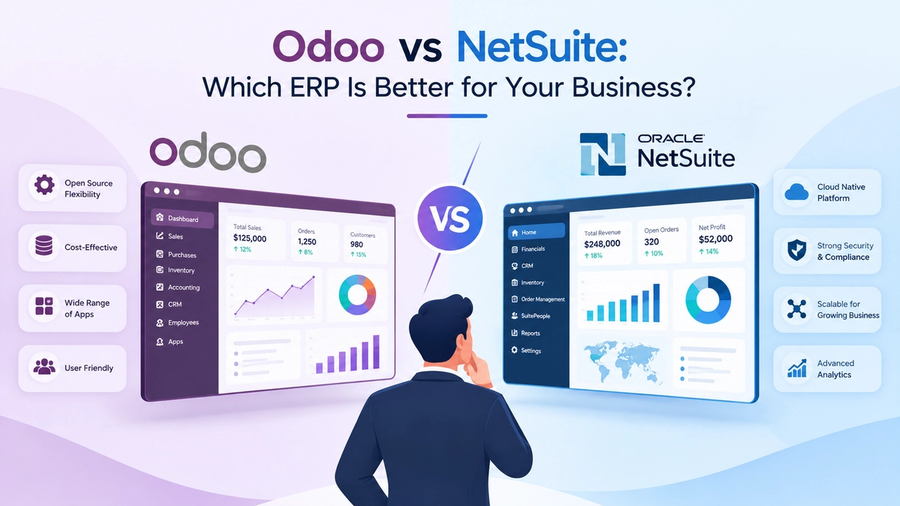
Every business wants success. That’s why they always prefer the best things in their organization. Choosing the right ERP system is one of the most important decisions they make for their business. The right system can bring finance, sales, inventory, and operations together in one place. The wrong choice can lead to extra costs, changes, and even a new system a few years later.
But the confusion arises when you have two best ERP options available: Odoo and NetSuite. Both offer cloud-based solutions and cover most business functions but they are designed for different types of businesses. These differences can affect pricing, features, customization, implementation, scalability, and industry fit.
To remove your confusion, you need to know the difference between Odoo and NetSuite. So let’s discuss it in detail.
Quick Answer: Odoo vs NetSuite
| Odoo is an open-source, modular ERP that is a good choice for small and mid-sized businesses, with up to around 250 employees. It offers flexible customization and can be more affordable for businesses that want a system they can adapt to their needs. NetSuite is Oracle's cloud-based ERP designed for mid-sized and larger businesses, including companies with multiple subsidiaries or locations. It provides strong financial management, reporting, compliance controls, and support for multiple currencies. So the right choice depends on your business size, budget, structure, and specific needs. |
|---|
What Is Odoo?
Odoo is an open-source business management system with more than 80 integrated apps for areas such as accounting, CRM, inventory, manufacturing (MRP), point of sale, HR, project management, and e-commerce. Its modular design helps businesses use only the apps they need. Since all the apps use the same database, they can easily share and update business data.
Odoo is available in two editions:
- Community Edition: A free, open-source version that businesses can host themselves and use for core features.
- Enterprise Edition: A paid version that includes additional features, official support, cloud hosting options, and tools for customization.
Because Odoo is open source, businesses and implementation partners can customize many parts of the system. This flexibility makes Odoo useful for startups, manufacturers, e-commerce businesses, and service companies with workflows that standard software does not fully support.
What Is NetSuite?
Oracle NetSuite is a cloud-based ERP where all customers use the same core version of the software, hosted and managed by Oracle. It was one of the early cloud ERP systems and is widely used by mid-sized and large businesses, especially companies with multiple subsidiaries, currencies, or complex reporting needs.
NetSuite's main strength is financial management and consolidation. It includes tools such as SuiteAnalytics and built-in multi-entity management to help businesses manage finances across different companies, business units, or countries. Its financial close tools also support businesses with complex reporting requirements.
NetSuite can be customized using SuiteScript and SuiteCloud but these customizations require experienced or certified NetSuite developers. Unlike open-source systems, businesses have less freedom to modify the platform themselves.
NetSuite does not publish fixed list prices. The cost is usually based on factors such as the modules, number of users, and level of customization required.
Odoo vs NetSuite: A Quick Comparison
| Category | Odoo | NetSuite |
|---|---|---|
| Best for | Startups, small and mid-sized businesses, and growing service or manufacturing companies | Mid-sized and large businesses, especially those with multiple entities |
| Company size | Roughly 1–250 employees | Roughly 50–5,000+ employees |
| Pricing model | Per user and app but Community Edition is free | Per user plus a base platform fee and custom pricing |
| Typical starting cost | About $24–$39 per user/month for Enterprise | About $999–$5,000/month base fee plus $99–$200 per user/month |
| Typical 3-year cost | About $10,000–$80,000 for small and mid-sized deployments | About $100,000–$500,000+ for mid-market deployments |
| Deployment | Self-hosted, Odoo Cloud, or partner-hosted | Oracle-hosted cloud |
| Customization | Highly customizable because it is open source; can be handled in-house or by a partnerAbout 1–4 months for standard setups | Customizable through SuiteScript and SuiteCloud, usually with experienced developers |
| Implementation time | About 1–4 months for standard setups | About 4–9 months for standard setups |
| Multi-company management | Basic to moderate, with improvements in newer versions | Strong tools designed for multiple subsidiaries and financial consolidation |
| Manufacturing | Strong features for MRP, PLM, quality control, and work orders | Moderate; additional modules needed |
| Learning curve | Low to moderate and easy to use | Moderate to steep |
| Support | Community forums, implementation partners, and paid Enterprise support | Vendor-managed support based on the contract |
Pricing and Total Cost of Ownership
Pricing is one of the biggest differences between Odoo and NetSuite and is an important factor when choosing an ERP.
- Odoo charges based on users and the apps you choose. Enterprise plans mostly start around $24–$39 per user per month while the Community Edition has no license cost if you self-host it. For a small business with 10–20 users, monthly subscription costs can be around $700–$1,500 with additional implementation costs depending on customization and setup needs.
- NetSuite does not publish fixed prices. Its contracts usually include a base platform fee of around $999–$5,000 per month, plus $99–$200 per user per month. Its implementation costs can also be high, especially for businesses with complex requirements.
Over three years, Odoo is less expensive for small and mid-sized businesses while NetSuite can cost more because of its platform fees and implementation requirements. But NetSuite's higher cost can include advanced financial and multi-entity features that larger businesses may need.
Customization and Flexibility
Every business needs a workflow that standard software does not support. That’s where Odoo and NetSuite differ.
Odoo is open source so its code can be reviewed and modified. Businesses can customize existing modules, create new ones, and change workflows with their own developers or an implementation partner. This flexibility is useful for manufacturers and service businesses with specific processes.
NetSuite uses SuiteScript and the SuiteCloud platform for customization. These tools are powerful but they are proprietary and require experienced NetSuite developers. Larger changes also need a more structured development and approval process. This can provide more control for larger businesses but take more time and resources.
Implementation Timeline
Time-to-value is important, especially for the smaller businesses that don’t have months to implement a new ERP system.
For most standard needs an Odoo implementation will take between 1 and 4 months. It’s modular, so companies can get started with basic apps and add more later. The simple interface can also make it easier for employees to learn.
Most NetSuite implementations take 4-9 months since there's more configuration, multi-entity setup, accounting structures, data migration and integrations. This longer process can help build a system that works for businesses with complex operations from day one.
Reporting, Business Intelligence, and User Experience
NetSuite has a strong built-in reporting system called SuiteAnalytics. It is designed for financial reporting, consolidation, and dashboards across multiple business units, making it useful for finance teams.
Odoo also provides built-in reporting for everyday business needs. For more advanced dashboards and real-time analytics, businesses can connect Odoo with dedicated BI tools for deeper reporting.
For daily use, Odoo has a modern and simple interface that many employees can learn quickly. NetSuite offers more advanced features and configuration options but new users need more training to use the system effectively.
Industry and Use-Case Fit
Odoo is a good fit for:
- Ecommerce and retail businesses that need inventory and online store integration
- Manufacturers that need MRP, bills of materials and quality control
- Service businesses and agencies that want to have project management, billing and CRM all in one place
- Startups & small businesses looking for predictable & flexible
NetSuite is a good fit for:
- Businesses with multiple subsidiaries or international operations
- Companies with complex revenue, billing, or compliance requirements
- Businesses that have outgrown QuickBooks or similar accounting software
- Companies that prefer a vendor-managed ERP with less need for in-house customization
Odoo vs NetSuite: Pros and Cons
Pros of Odoo
- Cost savings
- Open source and highly customizable
- Faster implementation
- Have strong features of manufacturing and inventories
- Simple and modern interface
Cons of Odoo
- Less advanced multi-company consolidation
- Support can differ by implementation partner
- More management is required for self-hosting
Pros of NetSuite
- Powerful multi-company financial consolidation
- Managed cloud platform
- Strong compliance and audit capabilities
- Perfect for large and growing businesses
Cons of NetSuite
- Increased subscription and implementation costs
- Longer implementation time
- For customization skilled developers are needed
- More training needed for new users
Which ERP Should You Choose?
The right ERP depends on your business size, budget, and needs. Odoo can be a good choice for smaller businesses like if you have under 50 employees or 50–250 employees that need simple operations and also customization or a faster implementation.
NetSuite is more suitable for businesses with multiple subsidiaries, currencies, complex compliance needs, or advanced financial reporting requirements like Preparing for an IPO, audit, or detailed investor reporting. Ultimately, choose the platform that best matches your current operations and future growth plans.
Frequently Asked Questions
Is Odoo cheaper than NetSuite?
Yes. Odoo is less expensive, especially for small and mid-sized businesses. NetSuite usually has a base platform fee in addition to user fees, which can increase the overall cost.
Can Odoo replace NetSuite for a growing business?
Odoo can cover essential areas such as finance, CRM, inventory, manufacturing and HR for many single entity businesses. For businesses with multi-company or international financial needs, the more advanced tools in NetSuite can be necessary.
Which ERP is easier to implement, Odoo or NetSuite?
Odoo is generally faster to implement. Standard Odoo projects take around 1-4 months while NetSuite implementations take around 4-9 months depending on business requirements and level of customization.
See Odoo Dashboards in action
Start a free 7-day trial and build your first dashboard in minutes — or book a walkthrough and we'll show you how your team would use it.