
Odoo vs SAP Business One: Which ERP Is Better for Your Business?
Muhammad Haroon
Choosing an ERP system is one of the most expensive and consequential decisions a growing business makes. And the two most prominent ERP platforms for small and mid-sized businesses are Odoo vs SAP Business One. Both are very powerful tools that’s why people get confused when making the final decision. A wrong decision here can lead to costly re-implementation in two or three years. That’s why you start reading guides and compare both of these tools to choose the right one. But what exactly makes one better than the other? Let’s discuss in detail.
Quick answer:
| Odoo is a better choice for small and mid-sized businesses that want lower costs, faster implementation, and an all-in-one platform for CRM, accounting, inventory, HR, and eCommerce. SAP Business One is better suited for businesses, especially in manufacturing and wholesale distribution, that need strong financial controls and are willing to invest more in licensing and certified implementation partners. |
|---|
What Is Odoo?
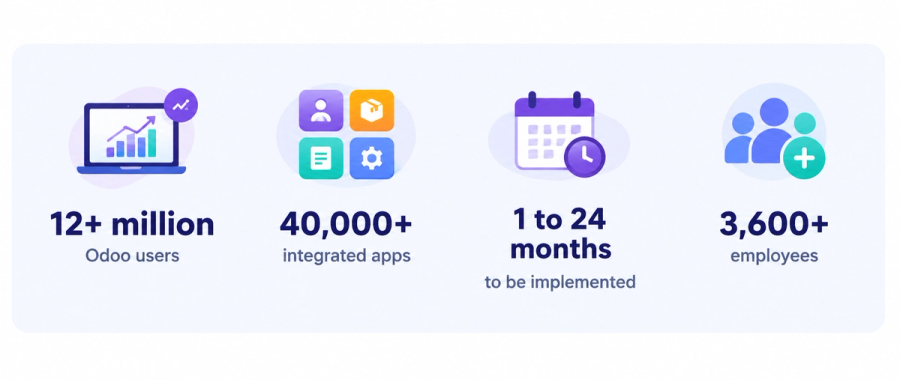
Odoo is an open-source ERP platform with more than 80 integrated apps including accounting, CRM, sales, inventory, manufacturing, HR, project management, and eCommerce. Businesses can start with the apps they need and add more as they grow. Odoo is available as a free and self-hosted Community edition or a paid Enterprise edition with hosting, premium apps, and support.
Odoo’s main advantage is its flexibility. A five-person company can start with just CRM and Invoicing at a low cost then add Inventory, Manufacturing, or HR later without changing platforms or training employees to use a completely new system.
What Is SAP Business One?
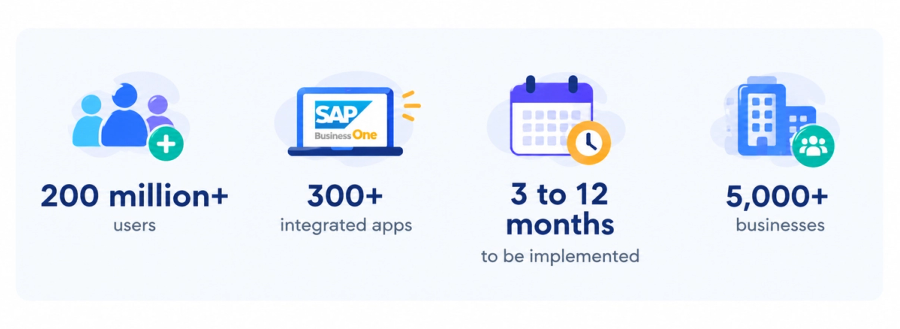
SAP Business One (SAP B1) is an ERP system from SAP designed specifically for small and mid-sized businesses. It is different from SAP S/4HANA, which is built for larger global companies. SAP B1 is sold and implemented through certified SAP partners and is especially popular in manufacturing, wholesale distribution, and businesses with complex financial reporting needs.
SAP B1 has fewer built-in customer-facing features than Odoo, such as no native eCommerce storefront. However, it is known for its strong financial and inventory management features. This makes it a good choice for companies that have outgrown basic accounting software but do not need a large system like SAP S/4HANA.
Odoo vs SAP Business One: A Quick Comparison
| Category | Odoo | SAP Business One |
|---|---|---|
| Deployment | Cloud or self-hosted | Cloud or on-premise |
| Pricing | Free option available and paid plans vary | Pricing is provided by SAP partners |
| Implementation | Usually faster | Usually takes longer |
| Best for | Startups and small to mid-sized businesses | Small to mid-sized businesses, especially manufacturers and distributors |
| Customization | Highly flexible and easy to customize | Customizable through SAP tools and partners |
| Modules | 80+ apps including CRM, eCommerce, HR, and marketing | Strong finance, inventory, and manufacturing features |
| Learning curve | Easier to learn | Requires more training |
| Support | Community, in-house teams, or Odoo partners | Certified SAP partners |
Feature-by-Feature Breakdown
Accounting and Financial Management
This is the major difference between these platforms. SAP Business One is known for strong financial features, including multi-currency support, detailed audit trails, and reporting for businesses with complex financial needs. If your business has strict compliance requirements or works across multiple legal entities, SAP B1 generally offers stronger financial tools.
Odoo has also improved its accounting features and can easily handle invoicing, bank reconciliation, multi-currency transactions, and standard financial reports for most small and mid-sized businesses. It fulfils the needs of most growing companies but businesses with complex financial structures find SAP B1 more powerful without needing extra add-ons.
Verdict: SAP Business One is better for complex financial reporting and compliance. Odoo is more than enough for standard SMB accounting needs and usually costs much less.
CRM and Sales
Odoo’s CRM is one of its strongest features. It includes pipeline management, lead scoring, email marketing, and quotation tools that connect directly with sales and invoicing. CRM, eCommerce, marketing, and the website are all part of the same platform. Customer information can move smoothly through the entire sales process without extra tools.
SAP Business One also has CRM features but they are generally more basic than Odoo’s. SAP focuses more on back-office operations while Odoo offers stronger tools for customer engagement and sales.
Verdict: Odoo is the better choice for businesses that want CRM, marketing, and eCommerce connected directly to their ERP.
Inventory and Supply Chain
Both platforms are strong in this area but they have different strengths. SAP Business One is well known for warehouse and supply chain management, especially in manufacturing and distribution. It offers strong tools for serial and batch tracking, bin locations, and production planning.
Odoo’s Inventory uses a flexible rule-based system that makes it easy to manage multi-warehouse operations. It also connects directly with Odoo’s Manufacturing (MRP) and Purchase apps, making it easier to manage inventory and production in one place.
Verdict: Both tools are efficient here. SAP B1 is better suited to complex and highly regulated manufacturing while Odoo offers similar features with an easier learning curve for most SMBs.
Manufacturing (MRP)
Odoo’s Manufacturing module supports bills of materials, work orders, quality checks, and subcontracting. It is often a good choice for small manufacturers that want useful manufacturing tools without the complexity of a large enterprise system.
SAP Business One also offers strong manufacturing features designed for small and mid-sized manufacturers. It is especially useful for businesses that need detailed production tracking and more complex manufacturing processes.
Verdict: Both platforms are capable. SAP B1 is often a better choice for established manufacturers with complex production needs while Odoo works well for smaller, newer, or lean manufacturing businesses.
HR and People Management
Odoo includes built-in HR apps for recruitment, time off, appraisals, and payroll, although payroll availability depends on the country. Having these tools in the same system can be convenient for small businesses because they do not need a separate HR system.
SAP Business One does not offer as many built-in HR features and often requires third-party integrations for complete HR management.
Verdict: Odoo is the better choice for businesses that want HR features included in their ERP instead of paying for a separate system.
Reporting, Dashboards, and Business Intelligence
Odoo provides built-in dashboards and customizable reports across its apps. Businesses can also use Odoo BI and dashboard tools to track KPIs and analyze data from different modules in real time.
SAP Business One offers strong built-in financial and operational reporting. It also works with SAP Crystal Reports and SAP Analytics for more advanced business intelligence.
Verdict: Both are strong options. The best choice depends on whether your team prefers SAP’s established BI tools or Odoo’s visual, in-app dashboards.
Pricing: The Real Cost Difference
Pricing is another factor that is important for smaller businesses.
- Odoo provides clear and flexible pricing, including a free option for businesses that only need one app. Its plans vary based on the features and number of users. This option makes it easier for smaller businesses to control costs.
- SAP Business One is a relatively expensive tool. Its cost varies based on the deployment, users, and required features. In general, SAP B1 requires a larger investment than Odoo.
Implementation and customization can add to the cost of either platform. But Odoo is generally the more affordable choice for small and mid-sized businesses, especially those that are looking for an ERP so they can start small and expand over time.
Who Should Choose Odoo?
Odoo is the better choice if your business:
- Is a startup, small business, or mid-sized company that wants to keep ERP costs low.
- Wants CRM, eCommerce, marketing, and ERP tools all in one platform instead of using separate systems.
- Needs to get the ERP up and running quickly in weeks rather than months.
- Wants to add more modules as the business grows.
- Has an in-house technical team or a trusted partner to handle customization.
Who Should Choose SAP Business One?
SAP Business One is the best choice if your business:
- Works in manufacturing, wholesale distribution, or another industry where SAP has strong industry solutions.
- Has complex financial reporting needs or operates across multiple companies.
- Prefers a structured implementation managed by a certified partner.
- Is already part of a supply chain or company group that uses SAP.
- Has the budget to invest in strong, enterprise-level features rather than focusing on lower upfront costs.
FAQs
Is Odoo cheaper than SAP Business One?
Yes. Odoo is a more affordable option than SAP Business One. its flexible pricing options make it a budget-friendly tool for most small and mid-sized businesses.
Which ERP is easier to implement, Odoo or SAP Business One?
Odoo is faster and easier to implement. SAP Business One usually takes longer because it follows a more structured implementation process through certified partners.
Does Odoo have CRM and eCommerce built in?
Yes. Odoo includes CRM, eCommerce, marketing automation, and website tools in the same platform. SAP Business One has basic CRM features but does not include a native eCommerce storefront.
Is Odoo open-source, and is SAP Business One open-source?
Odoo is an open-source tool and also offers a free Community edition as well as a paid Enterprise edition. SAP Business One is proprietary software that is sold and implemented through certified SAP partners.
Which ERP is better for a small business just starting out?
For most small businesses looking for lower costs, quick setup, and an all-in-one platform, Odoo is a better option. SAP Business One can be a better choice as business operations become more complex.
See Odoo Dashboards in action
Start a free 7-day trial and build your first dashboard in minutes — or book a walkthrough and we'll show you how your team would use it.